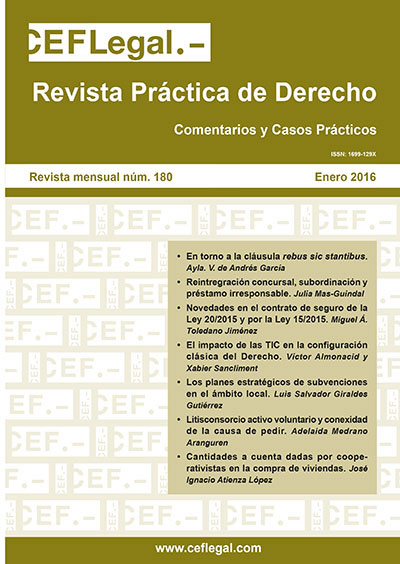
About clause rebus sic stantibus
DOI:
https://doi.org/10.51302/ceflegal.2016.10897Keywords:
civil law, contracts, obligations, Civil Code, clauseAbstract
The general rule in our law is pacta sunt servanda, a Latin phrase that is to mean that what was agreed forces, so that contracts are to be comply by the parties as agreed to and is reflected in our Civil Code specifically in his 1091 article, which states; «the obligations arising from contracts have the force of law between the contracting parties, and must be complied with under the same».
In contrast to this rule exists the rebus sic stantibus clause which is configured as an exception to the principle of loyalty and obligation of contracts. Under this clause contracts may be modified or subsequently resolved when the perfection of it supervening circumstances which may destroy the business base upon which the parties relied to carry out the contract arise. But that provision is not currently reflected in any legal body in our country. That is why its configuration has been carried out jin a exceptionally jurisprudence way and is constantly reiterated by the Supreme Court in several judgments that will be discussed in this work.
The use of this clause has emerged as a result of the economic crisis to try by implementing this change or terminate certain contracts. That is why in 2009 the Law Commission drafted the Proposed Draft Law on Modernization of the Civil Code on Obligations and Contracts, whose book IV, «Obligations and Contracts», includes a chapter VIII, entitled «From the extraordinary alteration of the basic circumstances of the contract», with a new article 1213 referred to this principle. So if the proposal is approved, this figure would set legally collected in addition to the principle pacta sunt servant.
Downloads
References
Albaladejo, M. [1989]: Derecho Civil, vol. II, Barcelona: Bosch.
Alejandre García-Cerezo, F. M.; Luna Yerga, Á. y Xiol Bardají, M.ª [2013]: «Crisis económica y cláusula rebus sic stantibus: ¿Cambio de vía en la jurisprudencia reciente del Tribunal Supremo?», Revista Aranzadi Doctrinal, n.º 3, junio, pág. 5.
Amunátegui Rodríguez, C. [2003]: La cláusula rebus sic stantibus, Valencia: Tirant lo Blanch.
Casella, G. [2001]: La risoluzione del contratto per eccesiva onerosità sopravvenuta, Turín: UTET.
Castañeda Rivas, M. L.: (http://www.juridicas.unam.mx/publica/librev/rev/facdermx/cont/258/art/art10.pdf).
Comentarios Oficiales a los Principios sobre los Contratos Comerciales Internacionales [2001]: publicados por el Instituto Internacional, Roma, (http://www.unidroit.org/spanish/principles/contracts/principles2004).
De Aquino, T.: La Suma Teológica (http://efrueda.com/wp-content/uploads/2011/12/suma_teologica_2_2.pdf).
De Castro y Bravo, F. [1985]: El negocio jurídico, Madrid: Civitas.
Díez-Picazo, L. [2008]: Fundamentos del Derecho Civil Patrimonial II. Las relaciones obligatorias, Madrid: Thompson Civitas.
Díez-Picazo, L. y Gullón, A. [2012]: Sistema de Derecho Civil, vol. II, t. I, Madrid: Tecnos.
Díez-Picazo, L.; Morales Moreno, A. y Roca Trías, E. [2002]: Los Principios del Derecho Europeo de Contratos, Madrid: Civitas.
Flume, W. [1998]: El negocio jurídico (trad. J. M. Miquel González y E. Gómez Calle), Madrid: Fundación Cultural del Notariado.
Lacruz Berdejo, J. L. [1999]: Elementos de Derecho Civil. Derecho de Obligaciones (revisada por F. Rivero Hernández y otros), Madrid: Dykinson.
Lando, O. y Beale, H. (eds.) [2000]: Principles of European Contract Law, parts I and II, elaborados por The Commision of European Contract Law, La Haya: Kluwer Law International, .
Larenz, K. [2002]: Base del negocio jurídico y cumplimiento de los contratos (trad. C. Fernández Rodríguez), Granada: Comares.
Lenel, O. [1923]: «La cláusula rebus sic stantibus» (trad. W. Roces), Revista de Derecho Privado, págs. 193 y ss.
Martínez Velencoso, L. M.ª [2003]: La alteración de las circunstancias contractuales, Madrid: Thompson Civitas.
Orduña Moreno, F. J. y Martínez Velencoso, L. M.ª [2013]: La moderna configuración de la claúsula rebus sic stantibus, Navarra: Civitas Thompson Reuters.
Salvador Coderch, P. [2011]: «Alteración de circunstancias en el artículo 1.213 de la Propuesta de Modernización del Código Civil en materia de Obligaciones y Contratos», en Indret, 4/2009, y Boletín del Ministerio de Justicia (www.mjusticia.es/bmj).
Von Bar, C. y Clive, E. (eds.) [2009]: Principles, definitions and model rules of European Private Law. Draft Common Frame of Reference (DCFR), vol. 1, elaborados por The Study Group on a European Civil Code y The Research Group on EC Private Law (Acquis Group), Múnich: Sellier.