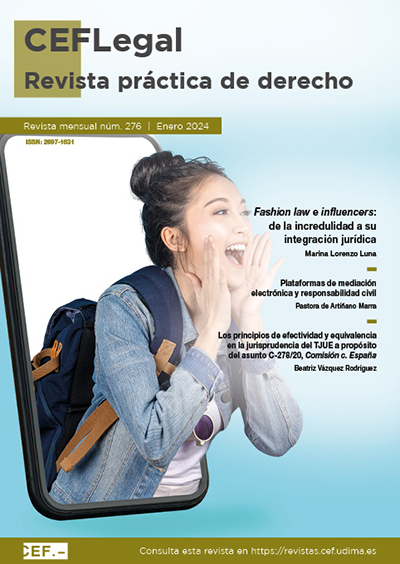
Fashion law and influencers: from incredulity to their legal integration
DOI:
https://doi.org/10.51302/ceflegal.2024.19037Keywords:
fashion law, influencers, followers, haters, social media, content creatorAbstract
The beginnings of fashion law and the figure of the influencer are highly synchronous as both were underestimated and currently stand out for having achieved well-deserved social and legal recognition. Furthermore, the fashion sector was a pioneer in taking risks with the collaboration of influencers to reach a greater number of potential clients. Thus, lawyers specializing in this field will be able to provide sound advice to those who, focusing on this sector, find a source of income and have to adapt to a new regulatory landscape that pays greater attention to them. Nevertheless, although this landscape/law has not yet fully materialized, they will have to be aware of the liabilities entailed in order to avoid situations that may affect them at a legal level. Recent general Law 13/2022, of July 7, 2022, on audiovisual communication, recognizes the influencer’s relevance from the advertising expenditure and consumer perspective. Regarding this law, we wish to highlight the following: the legal provision for tax purposes aimed at avoiding economic migration to countries with a light tax burden, the establishment of a state register of providers of these services, the promotion of codes of conduct, the prohibition of covert advertising, the obligation to clearly identify commercial communications as well as a wide range of infringements and penalties of up to 600,000 euros. Its entry into force is not yet complete with regards to some of the articles that respond to many of the questions motivating it, so it will be necessary to wait for its regulatory development to assess its effectiveness. On the other hand, this recognition must allow them to demand greater protection in the performance of their activity against criminal behaviour on the part of haters or followers, since despite finding a punitive provision in our Penal Code, it is not effective in its applicability due to the difficulty of identifying or locating the person hiding behind a social media account to discredit or harm the influencer.
Downloads
References
AEA (Asociación Española de Anunciantes). (2023). Más de 900 personas asisten a la Jornada sobre «La regulación y la autorregulación del marketing de Influencers» organizada por la AEA y Autocontrol. https://www.anunciantes.com/noticia/mas-800-personas-asisten-la-jornada-la-regulacion-la-autorregulacion-del-marketing-influencers-organizada-la-aea-autocontrol/
Autocontrol. (2020). Código de conducta sobre el uso de influencers en la publicidad. https://www.autocontrol.es/wp-content/uploads/2020/10/codigo-de-conducta-publicidad-influencers.pdf
Consejo General de la Abogacía Española. (17 de enero de 2022). «Legal influencers»: Juristas que triunfan en redes sociales acercando el derecho al ciudadano. https://www.abogacia.es/actualidad/noticias/legal-influencers-juristas-que-triunfan-en-redes-sociales-acercando-el-derecho-al-ciudadano
Echeverría, P. (2015). ¿Qué es el Derecho de la Moda? En S. Bello Knoll y P. Echeverría (Coords.), Derecho y Moda. Marcial Pons.
Garrigues y Boletín Oficial del Estado. (2023). Código de la Moda, Selección y ordenación.
Grupo Ático 34. (2022). Trolls en Internet: los tipos de trolling que encontrarás en la red. https://protecciondatos-lopd.com/empresas/trolls-internet-tipos-trolling
IAB Spain. (2021). Libro blanco marketing de influencia.
Kemp, S. (2023). Instagram users, stats, data & trends. https://datareportal.com/essential-instagram-stats
RAE (Real Academia Española). Influencer. En Observatorio de palabras.
Scafidi, S. (2015). Fashion Law: Diseñando una nueva disciplina. En S. Bello Knoll y P. Echeverría (Coords.), Derecho y Moda. Marcial Pons.
Stop Haters. (2020). Éxito legal de StopHaters. https://www.stophaters.es/post/%C3%A9xito-legal-de-stophaters
Downloads
Published
Versions
- 2023-12-29 (2)
- 2023-12-15 (1)