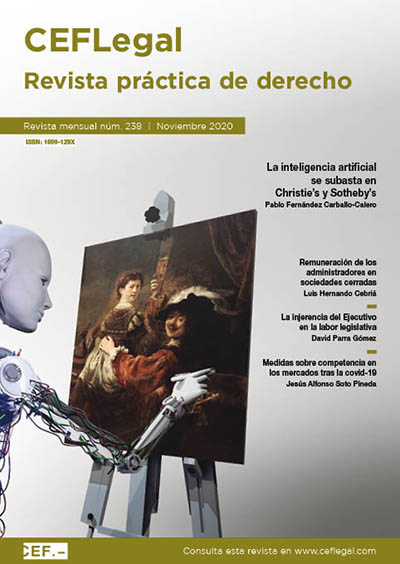
Artificial intelligence in auction at Christie’s and Sotheby’s: Towards a new concept of authorship in intellectual property law?
DOI:
https://doi.org/10.51302/ceflegal.2020.9525Keywords:
artificial intelligence, intellectual property, artworksAbstract
It is a fact that artificial intelligence, thanks to the unstoppable development of technology and science, has now the potential to create works susceptible to intellectual property protection. Nevertheless, the possibilty to protect the results generated by intelligent machines under this legal realm is subject to debate. In any event, the appearance of artificial intelligence in a field traditionally reserved to natural persons it is a reality to be faced.
The decision to protect the works of artificial intelligence points directly towards the core of intellectual property. With the aim to bring some light on this new and unresolved issue, the present paper makes a distinction between works developed by machine in an entirely autonomous ways and works in whose results humans have had an input. The analysis undertaken will lead us to decide, in the end, if the new game rules require a reformulation of the concept of authorship, if the results generated by artificial intelligence are outside the scope of intellectual property protection or if, finally, there is a possible confluence allowing the observation of intelligent machines as allies in the creative process.
Downloads
References
Allen, L. E. (1957). Symbolic Logic: A Razor-Edged Tool for Drafting and Interpreting Legal Documents. Yale Law School Faculty Scholarship Series, paper 4519.
Azuaje Pirela, M. (2020). Protección jurídica de los productos de la inteligencia artificial en el sistema de propiedad intelectual. Revista Jurídica Austral, 1(1).
Bently, L. et al. (2018). Intellectual Property Law. (5.ª ed.). Oxford University Press.
Bercovitz Rodríguez-Cano, A. (Dir.). (2011). Comentarios a la Ley de Competencia Desleal. Madrid.
Bercovitz Rodríguez-Cano, R. (2007). Comentario al artículo 10. En R. Bercovitz Rodríguez-Cano (Coord.), Comentarios a la Ley de Propiedad Intelectual. (3.ª ed.). Tecnos.
Brandom, R. (1 de junio de 2016). Google's art machine just wrote its first song. https://www.theverge.com
Bridy, A. (2012). Coding Creativity: Copyright and the Artificially Intelligent Author. Stanford Technology Law Review, 5.
Castells i Marqués, M. (2019). Cocreación artística entre humanos y sistemas de inteligencia artificial. En Navas Navarro (Dir.), Nuevos desafíos para el derecho de autor. Robótica, inteligencia artificial, tecnología. Reus.
Denicola, R. C. (2016). Ex Machina: Copyright Protection for Computer-Generated Works. Rutgers University Law Review, 69.
Dorstter, L. (8 de enero de 2009). Le concept d’originalité dans la législation française du droit d’auteur et dans celle du copyright anglais. Les blogs pédagogiques de l’université Paris Nanterre.
Ginsburg, J. C. y Budiardjo, L. A. (2019). Authors and Machines. Berkeley Technology Law Journal, 34.
Guadamuz, A. (2017). Artificial intelligence and copyright. Revista OMPI, octubre.
Hristov, K. (2017). Artificial intelligence and the copyright dilemma. IDEA, The IP Law Review, 57(3).
Hopfield, J. J. (1982). Neural networks and physical systems with emergent collective computational abilities. Proceedings of the National Academy of Sciences of the United States of America, 79.
Iglesias, M., Shamuilia, S. y Anderberg, A. (2019). Artificial Intelligence and Intellectual Property - A Literature Review. EUR 30017 EN (Oficina de Publicaciones de la Unión Europea).
Jones, J. (6 de abril de 2016). The digital Rembrandt: a new way to mock art, made by fools. The Guardian.
Jordan, L. (13 de abril de 2017). Inside the Lab That’s Producing the First AI-Generated Pop Album. Seeker.
Massaguer, J. (1999). Comentario a la Ley de Competencia Desleal. Civitas.
Merrill, B. (17 de diciembre de 2014). It’s Happening: Robots May Be the Creative Artists of the Future. Make Use Of.
Miller, A. R. (1993). Copyright Protection for Computer Programs, Databases, and Computer-Generated Works; Is Anything New Since CONTU? Harvard Law Review, 106(5).
Navas Navarro, S. (2018). Obras generadas por algoritmos: en torno a su posible protección jurídica. Revista de Derecho Civil, 5(2).
Noto la Diega, G. (10 de marzo de 2020). Comments on WIPO’s ‘Draft Issues Paper on Intellectual Property and Artificial Intelligence’, p. 3.
Peinado Gracia, J. I. (2017). Comentario al artículo 10. Obras y títulos originales. En Palau Ramírez y Palao Moreno (Dirs.), Comentarios a la Ley de Propiedad Intelectual. Tirant lo Blanch.
Pitol, S. (7 de noviembre de 2017). Con inteligencia artificial se logró pintar el último retrato de Rembrandt. https://www.infobae.com
Rodríguez Tapia, J. M. (2009). Comentario al artículo 5. Autores y otros beneficiarios. En. Rodríguez Tapia (Dir.), Comentarios a la Ley de Propiedad Intelectual. Madrid.
Saiz García, C. (2017). Comentario al artículo 5. Autores y otros beneficiarios. En Palau Ramírez y Palao Moreno (Dirs.), Comentarios a la Ley de Propiedad Intelectual. Tirant lo Blanch.
Saiz García, C. (2019). Las obras creadas por sistemas de inteligencia artificial y su protección por el derecho de autor. InDret, 1/2019.
Sanjuán Rodríguez, N. (2019). Inteligencia artificial y propiedad intelectual. Actualidad Jurídica Uría Menéndez, 52.
Schaub, M. (22 de marzo de 2016). Is the future award-winning novelist a writing robot? The L.A. Times.
Schjeldahl, P. (8 de abril de 2016). A few words about the faux Rembrandt. The New Yorker.
Yanisky-Ravid, S. (2017). Generating Rembrandt: Artificial Intelligence, Copyright, and Accountability in the 3a Era - The Human-Like Authors are Already Here - A New Model. Michigan State Law Review, 659.