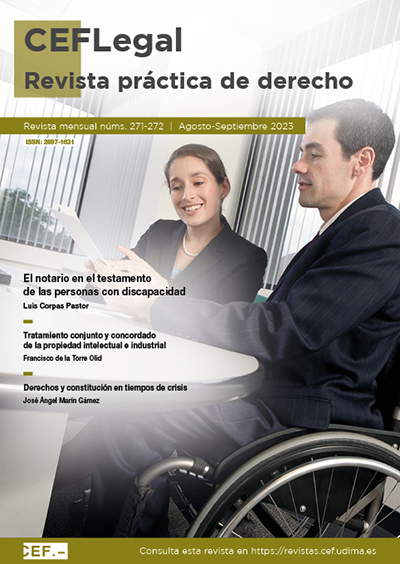
The notary as an atypical support measure in the will of people with disabilities
DOI:
https://doi.org/10.51302/ceflegal.2023.19243Keywords:
disability, will, natural legal capacity, support measures, notaryAbstract
The beginning of validity of the Spanish 8/2021 law, on the reform of civil and procedural legislation to support people with disabilities in the exercise of their legal capacity «BOE No. 132, of June 3», has involved a substantial modification of inheritance law, relating to promoting respect for the will and preferences of the person with a disability, and a boost to their autonomy in making their own decisions. In this work we make a comment on the transcendent modifications of the Civil Code introduced by this law, on the facilities that the legislator gives from now on to people with disabilities not only to grant a will, but to make decisions about their succession and the establishment of testamentary provisions in full autonomy of their will, also introducing the possibility of granting provisions for the benefit of certain relatives when they have the right to succeed them intestate, despite having had a relationship of guardianship, curatorship or mere caregivers of the person with a disability. Finally, we highlight the importance that the new law grants to the figure of the Notary Public in ensuring the reliable will of the person with disabilities and we mention the current technological possibilities whose validity is established in the Code by this reform, such as the electronic signature in the Electronic will or the peculiarities of the will for people with visual disabilities, by modifying article 25 of the Law of notaries.
Downloads
References
Albadalejo, M. (2002). Derecho Civil I. Introducción y Parte General. (15.ª ed.). Bosch.
Albadalejo, M. (2013). Curso de Derecho civil V. Derecho de sucesiones. Edisofer.
Alemany García, M. (2021). Sobre «Una crítica a los principios de la reforma del régimen de la discapacidad», réplica a la reseña de M. E. Torres Costas. Revista de Derecho Civil, VIII(3), 277-282.
Barba, V. (2021). La protección de las personas con discapacidad en el Derecho civil italiano a la luz del art. 12 de la Convención Sobre los derechos de las personas con discapacidad. Revista Cubana de Derecho, 1(1), 274-307.
Barrón Arniches, P. de. (2020). Personas con discapacidad y libertad para testar. Actualidad Jurídica Iberoamericana, 12, 448-471. http://hdl.handle.net/10459.1/68864
Bonete Satorre, B. (2021). El testamento de las personas con discapacidades sensoriales y otras discapacidades. Revista Jurídica de Castilla y León, 53, 121-146.
Campo Álvarez, B. del. (2018). La especial capacidad para testar. Actualidad Jurídica Iberoamericana. IDIBE, 8 bis, 265-274.
Castán Tobeñas, J. (1984). Derecho civil español común y foral. Tomo 1, Introducción y Parte general. Vol. II, Teoría de la relación jurídica. La persona y los derechos de la personalidad. Las cosas. Los hechos jurídicos. (14.ª ed.). Reus.
Cobas Cobiella, M. E. y Joz Latorre, C. de. (2017). La Modernización del derecho de sucesiones. Algunas propuestas. Cuestiones de Interés Jurídico. IDIBE. https://idibe.org/cuestiones-de-interes-juridico/la-modernizacion-del-derecho-de-sucesiones-algunas-propuestas/.
Corvo López, F. M. (2019). La capacidad para testar de las personas con discapacidad intelectual. Revista de Derecho Civil, VI(4), 135-170.
Díez-Picazo, L. y Gullón Ballesteros, A. (2017). Sistema de Derecho Civil. Vol. IV (tomo 2), Derecho de sucesiones. (12.ª ed.). Tecnos.
Fernández de Buján, A. (2011). Capacidad. Discapacidad. Incapacitación. Modificación judicial de la capacidad. RJUAM, I(23), 53-81.
García Rubio, M. P. (2018). Algunas propuestas de reforma del Código Civil como consecuencia del nuevo modelo de discapacidad. En especial en materia de sucesiones, contratos y responsabilidad civil. Revista de Derecho Civil, 5(3), 2018, 173-197
Lacruz Berdejo, J. L. (2009). Elementos de Derecho Civil V. Sucesiones. (4.ª ed.). Dykinson.
López San Luis, R. (2020). El principio de respeto a la voluntad de la persona con discapacidad en la Convención de Nueva York (2006), y su reflejo en el anteproyecto de ley por la que se reforma la legislación civil y procesal en materia de discapacidad. InDret, 2, 111-138.
Petit Sánchez, M. (2020). La adopción de medidas de apoyo para las personas con discapacidad. Revista de Derecho Civil, VII(5), 265-313.
Rogel Vide, C. (2017). El derecho a la herencia en la Constitución. Reus.
Sánchez Gómez, A. (2020). Hacia un nuevo tratamiento jurídico de la discapacidad. Reflexiones a propósito del proyecto de ley de 17 de julio de 2020 por la que se reforma la Legislación civil y procesal para el apoyo a las personas con discapacidad en el ejercicio de su capacidad jurídica. Revista de Derecho Civil, VII(5), 385-428.
Santos Morón, M. J. (2014). Lecciones de derecho civil patrimonial. Tecnos.
Torres Costas, M. E. (2020). Sobre la postergada (y necesaria) reforma de la regulación de los ingresos involuntarios y otros derechos fundamentales. Revista de Derecho Civil, VII(4), 265-285.
Verda y Beamonde, J. R. de. (2021). ¿Es posible seguir distinguiendo entre capacidad jurídica y capacidad de obrar? Tribuna. IDIBE. https://idibe.org/tribuna/posible-seguir-distinguiendo-capacidad-juridica-capacidad-obrar/
Downloads
Published
Versions
- 2023-08-30 (2)
- 2023-07-17 (1)