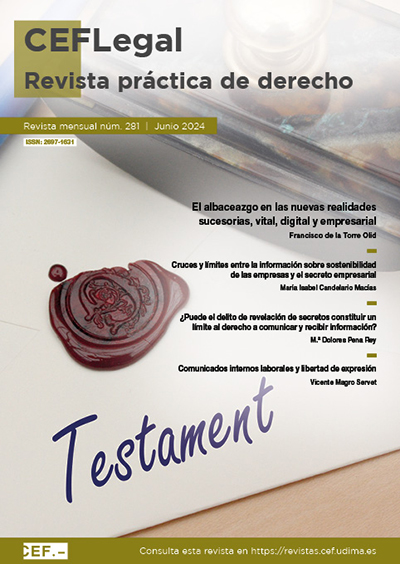
The executor in the new succession, vital, digital and business realities. A complex figure with a long tradition and a convenient projection today
DOI:
https://doi.org/10.51302/ceflegal.2024.21467Keywords:
executor, living will, digital will, mediation, succession mortis causaAbstract
Approaching the study of a figure with a long tradition is interesting because its survival over time evidences its interest, usefulness and effectiveness in legal practice. In addition, the executor shows a complexity that requires an abundance of points of the institution in order to deepen its clarification, while at the same time, by requiring comparison with other categories, it suggests an enriching work of contrast. In addition to all this, there are new issues and needs that the executor will serve in an ideal way to manage digital content of the deceased, to execute provisions committed to bioethics. In fact, the living will and the digital will justify the use of the executor by encouraging this testamentary designation, which adds to the complications that at present presents both at the most personal level and in the patrimonial order, such as the necessary harmonization and satisfaction of the interests of heirs of different marital ties and the demands of the administration and management of patrimonial assets increasingly linked to companies all the more so when it comes to family business and possible succession agreements must be taken into account. The interest of the executor’s task is explained, in addition, by the advantage of contributing to the out-of-court settlement of conflicts of interest that the succession exposes.
Downloads
References
Albaladejo García, M. (1978). Comentarios al Código Civil y Compilaciones Forales (Tomo XII, Vol. 2). Edersa.
Cicu, A. (1959). El Testamento. Editorial Revista de Derecho Privado.
Corpas Pastor, L. (2023). El notario en el testamento de las personas con discapacidad. CEFLegal. Revista Práctica de Derecho, 271-272.
Marín Castán, F. (2000). Comentario del Código Civil (Tomo 5). Edersa.
Máximo Juárez, J. (2019). El protocolo familiar: valor y eficacia jurídica, coordinación del protocolo con los estatutos sociales y con la organización jurídica personal de sus miembros. En El protocolo familiar: Consejos prácticos para su elaboración. Sección de Empresa Familiar de la Asociación Española de Asesores Fiscales.
Puig Brutau, J. (1975). Fundamentos de Derecho Civil (Tomo V, Vol. 1). Bosch.
Romeo Casabona, C. y Romeo Malanda, S. (2022). El bioderecho y su corpus iuris. Manual de Bioderecho. Dykinson.
Vallet de Goytisolo, J. (1984). Panorama de Derecho de Sucesiones II. Civitas.
Downloads
Published
Versions
- 2024-06-03 (2)
- 2024-05-17 (1)